
Red velvet ants (the famous “cow killer ants”) are not actually ants at all. They are solitary, ground-nesting wasps, so the colony-baiting tricks that work on regular ants do nothing here. To get rid of them: knock down the few you see with a wasp-and-hornet spray from a safe distance, never try to crush a female with your bare hand or foot (her armor-like shell shrugs off the pressure and her sting is brutal), and if they keep turning up in the same spot, dust the ground-bee or wasp burrows nearby, since that is where the females hunt and breed.
You are most likely to run into them in the heat of summer. Adults are active from spring through fall but peak in July and August, when females roam lawns, gardens, and sandy patches looking for host nests. The good news: they are loners that never swarm, they do not infest the inside of a house, and they sting only when grabbed or stepped on. Below is how to identify them, how dangerous they really are, and exactly how to clear them out without getting stung.
Red Velvet Ant Identification at a Glance
The big, fuzzy red insect crawling across your patio is almost always a female velvet ant. Use this quick table to tell the females (the ones that sting) from the harmless winged males, and to rule out look-alikes.
| Feature | Female (the stinger) | Male (harmless) |
|---|---|---|
| Wings | None, wingless | Two pairs of dark wings, can fly |
| Size | About 0.5 to 1 inch (12 to 25 mm) | Similar size, but slimmer |
| Color | Dense red, orange, or yellow velvety hair | Darker, more wasp-like |
| Sting | Yes, very painful | No stinger at all |
| Where seen | Running fast across open ground, lawns, sand | Flying low over the ground, near flowers |
What Is a Red Velvet Ant?
Velvet ants are a parasitic type of wasp, but people call them ants because of the dense hair covering the body, which is usually a vivid red, yellow, orange, or white. That bright “warning” coloring tells predators to stay away, and it is backed up by a tough exoskeleton and one of the most painful stings in the insect world.
Male Red Velvet Ant
Males look more like a wasp. They have wings, are darker in color, and you will rarely notice them. As with other wasps and ants, only the females carry a stinger, so a male velvet ant cannot hurt you. Males fly low over the ground searching for a mate, since the females are wingless.
Female Red Velvet Ants and Their Reproduction
When you see a big red velvet ant scurrying across the ground, you are almost certainly looking at a female. She gives off pheromones that help males find her. After mating, the female slips into the underground nest of a ground-dwelling bee or wasp and lays her eggs on the host’s developed larvae.
The eggs hatch quickly, and the young velvet ants feed on the host larvae for one to two weeks before pupating. They stay inside the host’s cocoon until late spring, then emerge on their own. Because the female can release chemical markers that disguise her as one of the colony, the host bees and wasps often do not notice the intruder. In this way velvet ants act as a natural check on local ground-bee and wasp populations.
Do Red Velvet Ants Fly?
Only the males fly, because only they have wings. The females are wingless and stay on the ground, which is why the insect you spot running across your yard cannot fly away. Even the males are weak fliers that stay low over the ground rather than rising high into the air.
Cow Killer Red Velvet Ant: Why the Name?
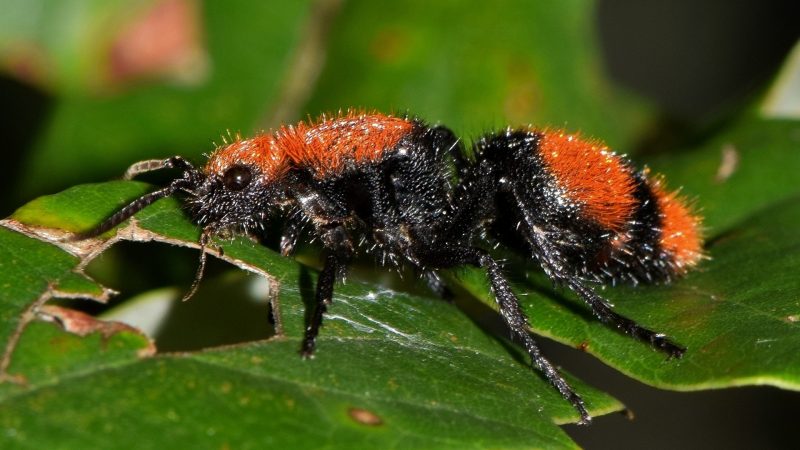
Red velvet ants earned the nickname “cow killer” because of how painful the female’s sting is, not because they can actually kill cattle. The sting is only mildly toxic. It hurts intensely, but it is not strong enough to kill a cow, a dog, or a person. The folklore simply says the pain is bad enough to kill a cow, which is a memorable exaggeration.
Where Do Red Velvet Ants Come From?
Red velvet ants are native to the eastern and southern United States. They are constantly on the move, do not build their own nests, and meet others of their kind mainly when mating.
Where Does the Red Velvet Ant Live?
They prefer open, sunny ground such as grasslands, meadows, pastures, and sandy lawns, the same places their host bees and wasps nest. You will usually meet one outdoors in the garden, and only rarely inside a house or garage, typically when heavy rain or a sudden weather change pushes one to seek shelter.
Because they are wasps rather than ants, they do not build ant hills or form large colonies. You will normally see a single velvet ant crawling quickly through grass or across bare soil.
Are Red Velvet Ants Rare?
They are not endangered, but they are uncommon to see in a typical yard, and you will almost never see more than one or two at a time. Because they are solitary and never arrive in numbers, you rarely need insecticide for them. Most encounters can be handled by simply removing the single insect.
Are Red Velvet Ants Dangerous?
Velvet ants are not dangerous to your house or yard, and they do no structural damage. The real concern is the female’s sting, which is famously excruciating even though the venom itself is only mildly toxic.
Only female red velvet ants sting; males have no stinger. The sting rates about a 3 on the four-point Schmidt sting pain index, and people who have felt it describe it as a hot, electric, long-lasting jolt. The intense pain usually fades within about 30 minutes. As with any wasp, a small number of people can have a serious allergic reaction (anaphylaxis), so if you notice spreading swelling, trouble breathing, dizziness, or a racing pulse after a sting, treat it as an emergency and seek medical care right away.
Red Velvet Ant Sting Symptoms
Reactions vary from person to person. Most people feel sharp, intense pain at the sting site and nothing more, while others get a mild to moderate local reaction. Possible symptoms include swelling, redness, and, in the rare case of a true allergy, trouble breathing, a change in pulse, low blood pressure, and anxiety driven by the extreme pain.
Red Velvet Ant Sting Treatment
If you do not have an allergic reaction and just want to ease the affected spot, these simple steps help:
- Wash and ice the area. Clean the spot with soap and water, then hold an ice cube or cold pack on it to slow blood flow and reduce pain and swelling.
- Try a salt or baking-soda paste. Mix table salt or baking soda with a little water into a paste and dab it on the sting to help numb the pain over a few minutes.
- Use an over-the-counter remedy if needed. An antihistamine or hydrocortisone cream can calm itching and swelling. Take a pain reliever if the ache is severe.
In most cases you will never get stung, because velvet ants are solitary and do not attack unless they are grabbed, stepped on, or trapped. The simplest protection is to give them room and never handle one.
Are Red Velvet Ants Poisonous?
Their venom is only mildly toxic, so the danger is the pain rather than poisoning. Ounce for ounce a bee or wasp attack can trigger a stronger physical reaction, yet a velvet ant sting hurts far more than a typical bee or wasp sting.
How Painful Is a Red Velvet Ant Sting?
It is one of the most painful insect stings in the world. On the Schmidt sting pain index, which runs from 1 to 4, the red velvet ant rates about a 3, while honey bees sit at a 1. Entomologist Justin Schmidt described the sensation as explosive and long-lasting, like hot oil spilled over your hand. The pain typically peaks fast and eases within roughly half an hour.
Are Red Velvet Ants Harmful to Humans?

For the great majority of people, no. The venom is only mildly toxic, and a sting cannot kill a healthy person. The main risk is the intense pain, plus the rare chance of an allergic reaction in someone who is sensitive to insect venom. A velvet ant will not chase you, and it stings only in self-defense, so keeping your distance is all the protection you need.
Are Red Velvet Ants Harmful to Dogs?
A velvet ant cannot kill a dog, but it can cause real pain. Curious dogs that paw or step on one may get stung on the foot, nose, or mouth. Most dogs are not allergic to the venom and recover on their own, but watch a stung dog for swelling around the face or throat, hives, vomiting, or weakness, and call your vet if any of those appear.
How to Get Rid of Red Velvet Ants
Because velvet ants are solitary wasps, not colony ants, you cannot bait them out the way you would ordinary ants. There is no nest of thousands to poison and no trail to follow back to a colony. Instead, you deal with the few individuals you actually see and make the area less inviting. Here is the practical order of attack:
- Spray the ones you see. Hit individual velvet ants with a wasp-and-hornet spray from a safe distance. Any product labeled for wasps works, since velvet ants are wasps. Aim, spray, and step back; do not lean in close.
- Do not rely on crushing them. A female’s tough, armor-like exoskeleton resists being squashed, and getting that close risks a sting. If you must step on one, use a thick-soled shoe and never go after one barefoot or with your hands.
- Treat the ground nests they target. If velvet ants keep showing up in the same area, the real draw is a cluster of ground-bee or wasp burrows nearby. Dusting those holes with an insecticidal dust labeled for ground-nesting wasps removes the host nests that velvet ants depend on, which is what actually breaks the cycle. Do this at dusk wearing long sleeves, pants, and closed shoes.
- Make the yard less attractive. Mow regularly, fill in bare or sandy patches where ground bees nest, and clear leaf litter, wood piles, and debris that give insects cover. A tidy, well-kept lawn gives both the host insects and the velvet ants fewer places to settle.
Two reliable products for spot-treating the wasps you see:
No products found.
No products found.
If you are finding velvet ants over and over, or you have a heavy population of ground bees and wasps you are not comfortable treating yourself, a licensed pest control professional can locate and dust the underground nests safely. This is the fastest route when the problem keeps coming back.
How to Keep Red Velvet Ants Out of Your House
Velvet ants almost never invade a home, because they are drawn to outdoor ground nests, not to your kitchen. So a true indoor infestation is very unlikely. The few that wander inside usually slip through a gap by accident. To keep them out:
- Seal entry points. Caulk cracks in walls and the foundation, add or repair door sweeps, and make sure window and door screens are intact.
- Cut back contact points. Trim branches and shrubs that touch the roof or windows, since these give insects a bridge indoors.
- Reduce nearby nesting sites. Keep the yard mowed and tidy and address any ground-bee or wasp burrows close to the house, since those are what attract velvet ants in the first place.
Frequently Asked Questions
What is the fastest way to get rid of a velvet ant?
Spray the individual insect with a wasp-and-hornet spray from a safe distance. Velvet ants are wasps, so wasp products work, and because they travel alone there is usually only one or two to deal with rather than a colony.
What time of year are velvet ants most active?
They are out from spring through fall but peak in the hottest part of summer, roughly July and August, when females are most active across lawns, gardens, and sandy ground. That is when most people first spot one.
Why do I keep seeing velvet ants in the same spot?
It almost always means there are ground-nesting bees or wasps nearby, which are the hosts velvet ants hunt for. Treating and removing those underground nests, rather than chasing single velvet ants, is what stops them from coming back.
Can a velvet ant sting kill you or your pet?
No. The venom is only mildly toxic, so a sting cannot kill a healthy person, dog, or cat. The danger is the intense pain, plus the rare risk of a severe allergic reaction, which needs immediate medical or veterinary care.
Are velvet ants beneficial or should I kill every one I see?
They are mostly beneficial, since they help control populations of ground-nesting bees and wasps and are not a household pest. If one is simply passing through an area where people and pets do not go, the easiest choice is to leave it alone and give it space.
List of Sources
Red Velvet Ant or “Cow Killer”, Texas A&M AgriLife Extension Service
Bessin R., Velvet Ants, University of Kentucky College of Agriculture
Orr D., Velvet Ant, NC State University Entomology
Manley D., Velvet Ants, Clemson University
Red Velvet Ants, National Institute of Environmental Health Sciences

- How to Get Rid of Copperheads | Practical Guide - August 27, 2023
- How to Get Rid of Corn Snakes | What Makes Them Aggressive? - August 27, 2023
- How to Get Rid of Alligators | Safety Measures and Removal Methods - July 16, 2023