
The false black widow (genus Steatoda) is a common house spider that is often mistaken for the dangerous black widow, but it is far less of a threat. The quickest way to tell them apart: a false widow has a purplish-brown to black, glossy, ball-shaped abdomen, usually with pale cream or yellowish markings (sometimes a faint skull or crescent shape) and reddish-brown legs. It never has the bright red hourglass that a true black widow wears on the underside of its belly. If there is no red hourglass, you are almost certainly looking at a harmless false widow.
A false widow bite is rare, roughly comparable to a bee sting, and clears up on its own within a day or two. They are shy, web-building spiders that hide in dark corners, cupboards, and garages and only bite if trapped against skin. Below is how to identify one with confidence, how it differs from the true black widow, what a bite feels like, and how to get rid of them and keep them out.
False Widow vs Black Widow: Identification at a Glance
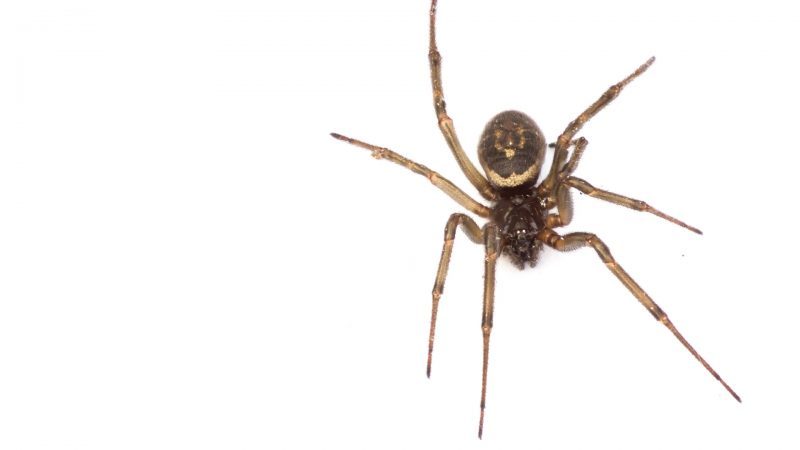
The two spiders look similar at a glance, which is exactly why false widows get killed (or feared) by mistake. Use this table to settle it fast. The single most reliable difference is the red hourglass: present on a black widow, absent on a false widow.
| Feature | False Black Widow (Steatoda) | True Black Widow (Latrodectus) |
|---|---|---|
| Red hourglass | None, ever | Bright red hourglass under the belly |
| Color | Purplish-brown to black, often glossy | Jet black and shiny |
| Markings | Pale cream, yellow, or orange skull or crescent shapes | Mostly plain black except the red hourglass |
| Body size (female) | About 6 to 10.5 mm (up to ~0.4 in) | About 13 mm (~0.5 in) |
| Bite danger | Mild, similar to a bee sting | Medically significant, can need treatment |
| Web | Tangled, messy cobweb in corners | Tangled cobweb low and hidden |
Related: Are Spiders Insects (Bugs), Arachnids, Mammals, or Reptiles?
What Is a False Black Widow Spider?
“False black widow” covers several spiders in the genus Steatoda that resemble true widow spiders (genus Latrodectus) without being closely dangerous. They build the same kind of irregular, tangled cobweb with sticky trip lines and often hang upside down in it waiting for prey. Some species are active year-round, indoors and out, in spots ranging from wall cracks to garden sheds. They are not aggressive and will not chase you; their whole strategy is to sit in the web and wait.
What Do False Widows Look Like?
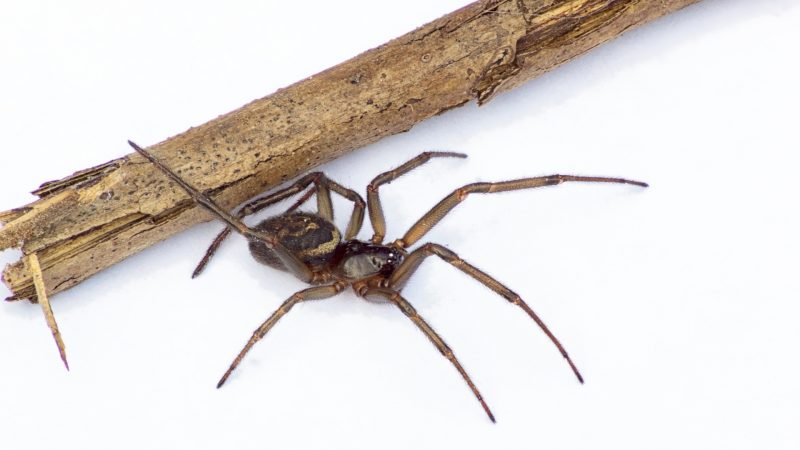
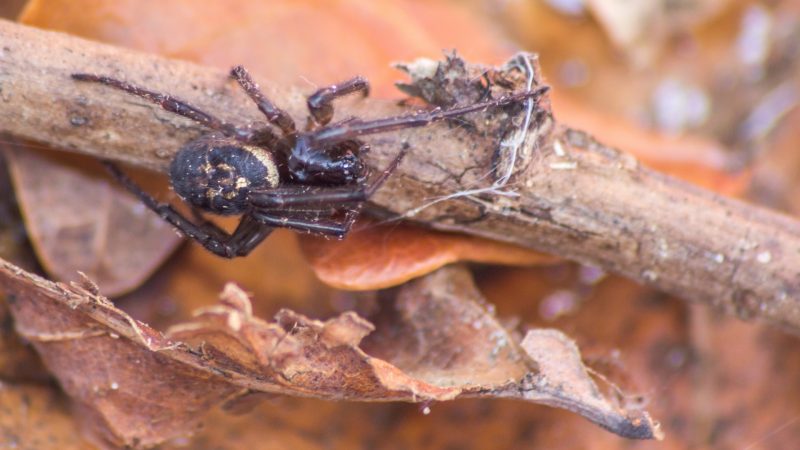
False widows have a bulbous, almost spherical abdomen that ranges from pale brown to nearly black, with the main body usually a purplish-brown. The front section (the cephalothorax) is reddish-brown with darker legs and is smaller than the round abdomen. Many specimens show pale cream, yellow, or orange markings on the abdomen, often shaped like a crescent, a triangle, or a faint skull. Those light patterns are exactly what makes people confuse the spider with a black widow. Newly hatched false widows are darker, much like the adult female.
How Big Are False Black Widow Spiders?
Females are larger than males, with a body length of about 6 to 10.5 mm (roughly 0.25 to 0.4 inch); the largest specimens approach 15 mm including the legs. Males are slimmer and reach about 10 mm (0.39 inch), with the same color pattern as the female but a more elongated body.
Do False Black Widows Jump?
No. False widows do not jump. Unlike hunting spiders that leap onto prey, these spiders build a web and wait for insects to blunder into it. They will not lunge at you either; when startled, a false widow runs for cover rather than toward you.
How Long Do False Black Widows Live?
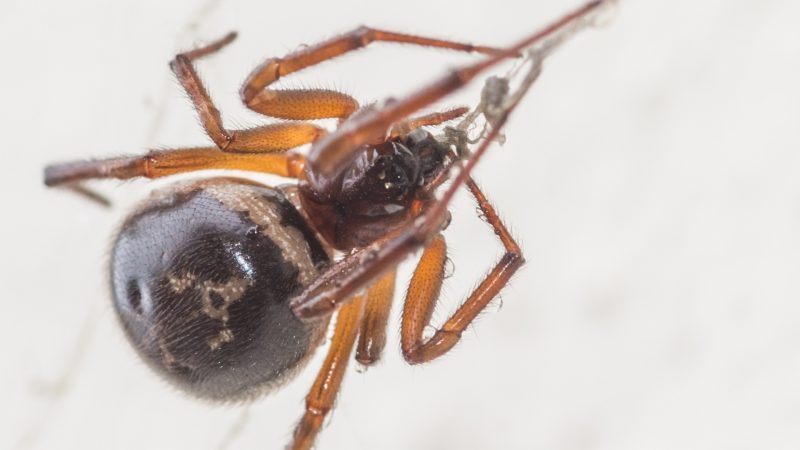
A typical false widow lives around 18 months, though females can survive up to about 6 years in good conditions. Males usually live around a year and a half, often dying soon after mating. Because they can persist for so long in a quiet cupboard or garage, a single spider you ignore can stay put for a long time, which is why removing them when you spot them is worthwhile.
Difference Between Black Widow and False Widow
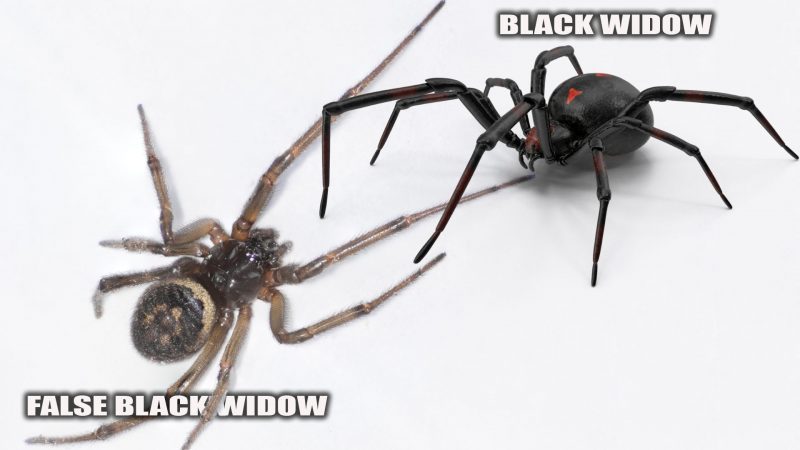
Beyond the quick table above, a few details settle any doubt:
- The hourglass is decisive. A mature female western black widow is glossy jet black with a vivid red hourglass on the underside of her abdomen. A false widow never has that red hourglass; at most its markings are pale cream, yellow, or orange on top of the abdomen.
- Color tone. Black widows are solid black. False widows usually carry a purplish or brownish tone, and any reddish coloring on them is dull, never the bright warning red of a widow.
- The young differ. Juvenile black widows look very different from the adult female, while young false widows already resemble their mother, just darker.
- Both sexes can bite, but mildly. In true black widows the female delivers the serious bite; in false widows, a bite from either sex is only a minor concern.
If you find a spider and genuinely cannot tell which it is, do not handle it. Capture it under a cup or call local pest control for a positive identification.
Do False Black Widow Spiders Bite?
Yes, but only by accident and only when one is pressed against your skin, such as inside a sleeve, glove, or shoe. False widows are not aggressive and do not seek people out. According to the University of California, a false widow bite typically causes an initial burning sensation followed by mild local irritation. Unlike a black widow bite, where pain is often delayed, false widow pain usually starts right away and stays localized.
At-home care is simple: wash the spot with soap and water, then apply an ice pack to ease pain and itching. Symptoms usually fade within one to three days. Keep the bite clean, because like any puncture wound it can occasionally get a secondary skin infection; see a doctor if the area becomes increasingly red, swollen, warm, or pus-filled.
Related: Can Spiders Bite Through Leggings?
What Does a False Black Widow Spider Bite Look Like?
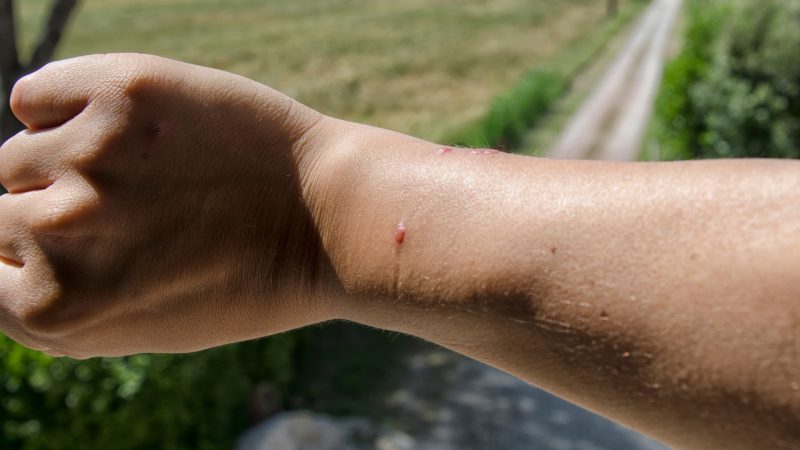
A false widow bite usually shows up as a small area of redness and slight swelling, sometimes with a blister at the center. Discomfort can build over the first hour and may come with a mild headache or tiredness. All symptoms generally resolve within about 60 hours. Other reported effects include:
- A general feeling of being unwell (malaise)
- Redness around the bite (erythema)
- Goosebumps near the site (piloerection)
- Brief facial flushing
Are False Black Widow Spiders Poisonous?
False widows do carry venom, which they use to subdue prey, but it is very weak against humans. The worst most people feel is short-lived pain and maybe mild nausea that passes in a day or two. It is not medically dangerous like a true black widow’s. That said, a small number of people are sensitive to spider venom, so seek emergency care right away if a bite is followed by any sign of a serious allergic reaction:
- Difficulty breathing
- A swollen face or throat
- Vomiting
- Dizziness
- Trouble swallowing
How Do You Get Rid of False Black Widow Spiders?
Because false widows are solitary and harmless, you usually only need to deal with the few you actually see, plus their webs. Here is the practical approach:
- Vacuum the spiders and webs. Run a vacuum over webs, egg sacs, and the spiders themselves in corners, under furniture, and along ceilings. Empty the bag or canister outside afterward.
- Catch and release the individuals. If you would rather not kill them, trap a spider under a cup, slide a piece of paper underneath, and carry it outdoors. They are beneficial predators of other insects.
- Cut off their food. Reduce the other insects in your home (the flies and small bugs false widows eat) and the spiders lose their reason to stay. A residual spider spray around entry points helps.
- Seal them out. Caulk cracks in walls and around pipes, add door sweeps, and repair window screens so new spiders cannot get in.
Related: How to Get Rid of Spider Eggs
What Repels False Black Widow Spiders?
Most products containing these active ingredients are effective at killing or repelling false widows around the home:
- Bifenthrin
- Cyfluthrin
- Deltamethrin
- Lambda-cyhalothrin
If you prefer a gentler approach, a ready-to-use plant-based spider spray is a good option for homes with children and pets, since it skips the synthetic pesticides. Products built around natural oils like cottonseed and clove oil produce a scent that deters spiders.
No products found.
A peppermint-oil-based spider repellent is another plant-based choice you can use indoors, in the garage, or in the car. It is safe around pets and children and works on a range of spider species.
No products found.
Related: Outdoor Spider Control
How to Keep False Black Widow Spiders Away

False widows dislike strong scents, so essential-oil sprays can help keep them out of the spots they like to hide. They tend to avoid:
- Peppermint
- Lemon
- Eucalyptus
- Tea tree oil
- Rosemary
- Lemongrass
- Citronella
Mix one of these oils with water in a spray bottle (use a generous amount of oil, since a stronger scent deters better) and apply it to windowsills, corners, and cupboards. Test the spray on a hidden spot first to make sure it will not stain furniture. Pair the scent barrier with the basics: keep clutter down so spiders have fewer hiding places, vacuum regularly, and seal entry points.
Related: How to Use Vinegar to Get Rid of Spiders
Frequently Asked Questions
How do I know if a spider is a false widow and not a real black widow?
Look for the red hourglass on the underside of the abdomen. A true black widow has a bright red hourglass; a false widow never does. False widows are also more purplish-brown with pale cream or yellow markings on top of the abdomen, while a black widow is solid glossy black.
Are false black widows dangerous to humans or pets?
Not really. Their venom is weak against people, and a bite is comparable to a bee sting that clears up in a day or two. They are not dangerous to cats or dogs in the way a true black widow can be. The only real risk is the rare allergic reaction or a secondary skin infection if a bite is not kept clean.
Why do I keep finding false widows in my house?
They are drawn to quiet, dark, undisturbed spots with a supply of other insects to eat, such as garages, basements, cupboards, and window frames. Reducing clutter, vacuuming webs, sealing cracks, and cutting down the insects they prey on removes both their shelter and their food.
Should I kill a false widow or leave it alone?
They are harmless and actually beneficial, eating flies and other pests, so there is no need to kill one. If it is somewhere out of the way, you can leave it. If it is in a high-traffic spot, the simplest option is to catch it under a cup and release it outdoors, or vacuum the web away.
Do false widow bites need a doctor?
Usually no. Wash the bite, apply ice, and it should settle within one to three days. See a doctor only if you notice signs of infection (spreading redness, warmth, pus) or any allergic reaction such as trouble breathing or facial swelling.
List of Sources
Burke Museum (2015). Myth: False Widows a danger in Britain, University of Washington
Our Water Our World (2016). Spiders, The Helpful Hunters, University of California
Jacobs, S. (2018). False Black Widow Spider, Penn State Extension
Vetter, R. S. (2017). Widow Spiders and Their Relatives, University of California Agriculture and Natural Resources

- How to Get Rid of Copperheads | Practical Guide - August 27, 2023
- How to Get Rid of Corn Snakes | What Makes Them Aggressive? - August 27, 2023
- How to Get Rid of Alligators | Safety Measures and Removal Methods - July 16, 2023